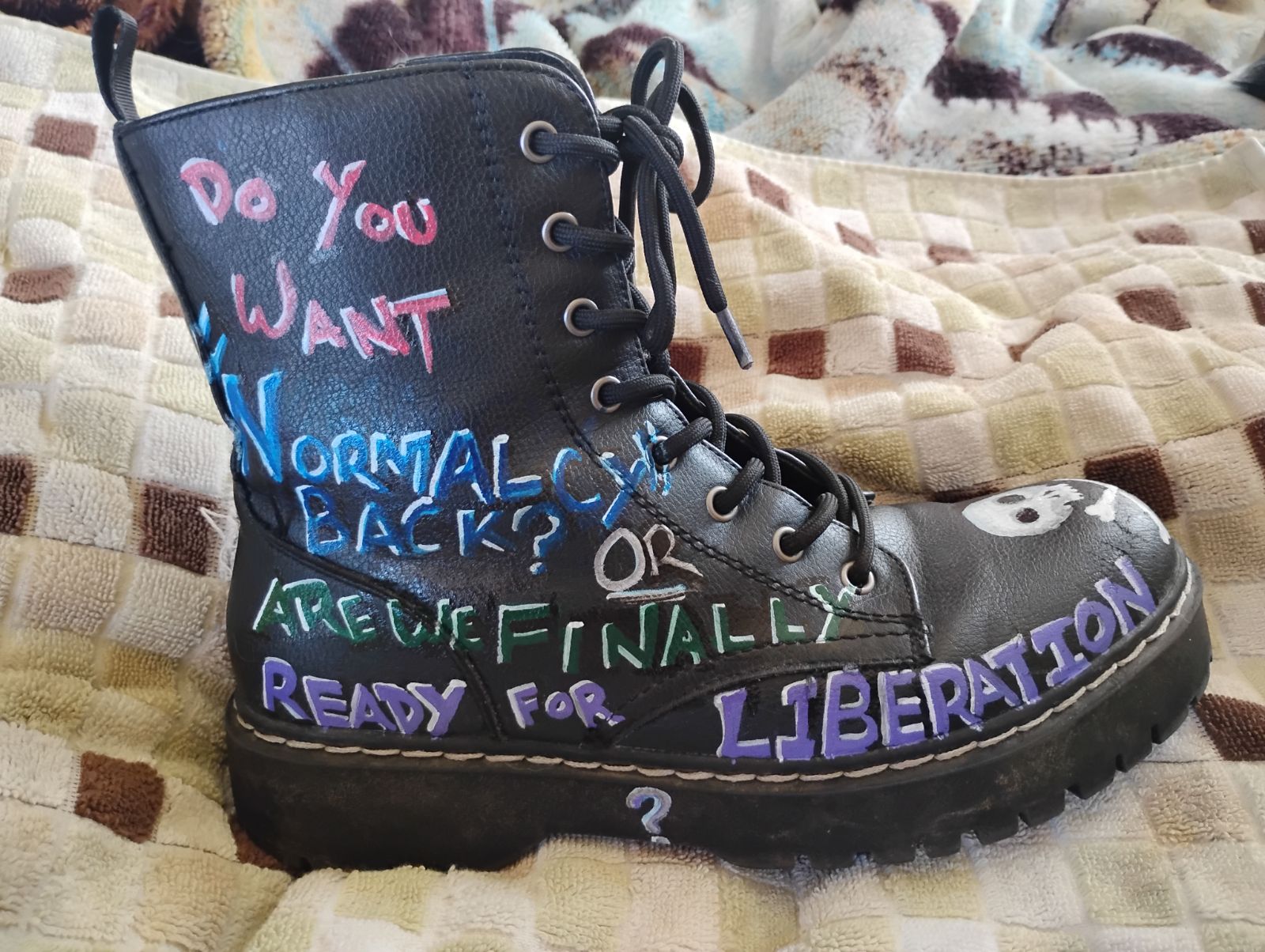
This isn't a policy explainer. It isn't a polite request for change. It's a warning, a testimony, and a battle cry. The people in this piece aren't asking for a seat at the table. They're describing a system that is actively trying to kill them. The experiences that you are about to read are from Jo-Disabled activists, grandmother, former worker, wheelchair user with Ankylosing spondylitis and other conditions. Lind-Disabled advocate, former lab tech, wheelchair user, former hospital worker, diagnosed with ME/CFS and many more. Nisha- Community member, niece of a stroke survivor. Story Community advocate, child of a father who needed end-of-life care. Helaine- 65-year-old great-grandmother, stroke survivor, former high stakes realtor, and guide dog user. Nicholas K. Young, MDiv, LMSW — Therapist, minister, writer. And myself, Jasmine, community advocate, interviewer and writer of this article. This article is for the disabled, by the disabled, and for anyone who thinks they're safe. You're not.
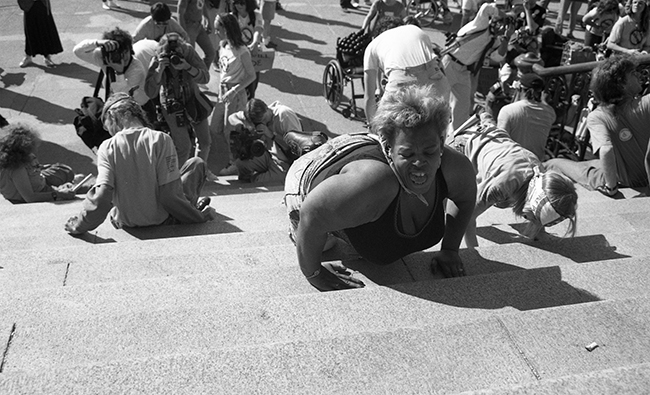
Thirty-six years ago, disabled people crawled up the Capitol steps having been left with no choice on the same day that America, our great nation, gifted its citizens with a hollow promise: the Americans with Disabilities Act. The very law that said patronized us by bestowing us the right to exist in public, to work, to ride the bus, to enter a building, to be treated like human beings. Our government believes itself a savior to give us the boon to matter legally from then on in spaces long ago designated for who they believed were the only deserving.
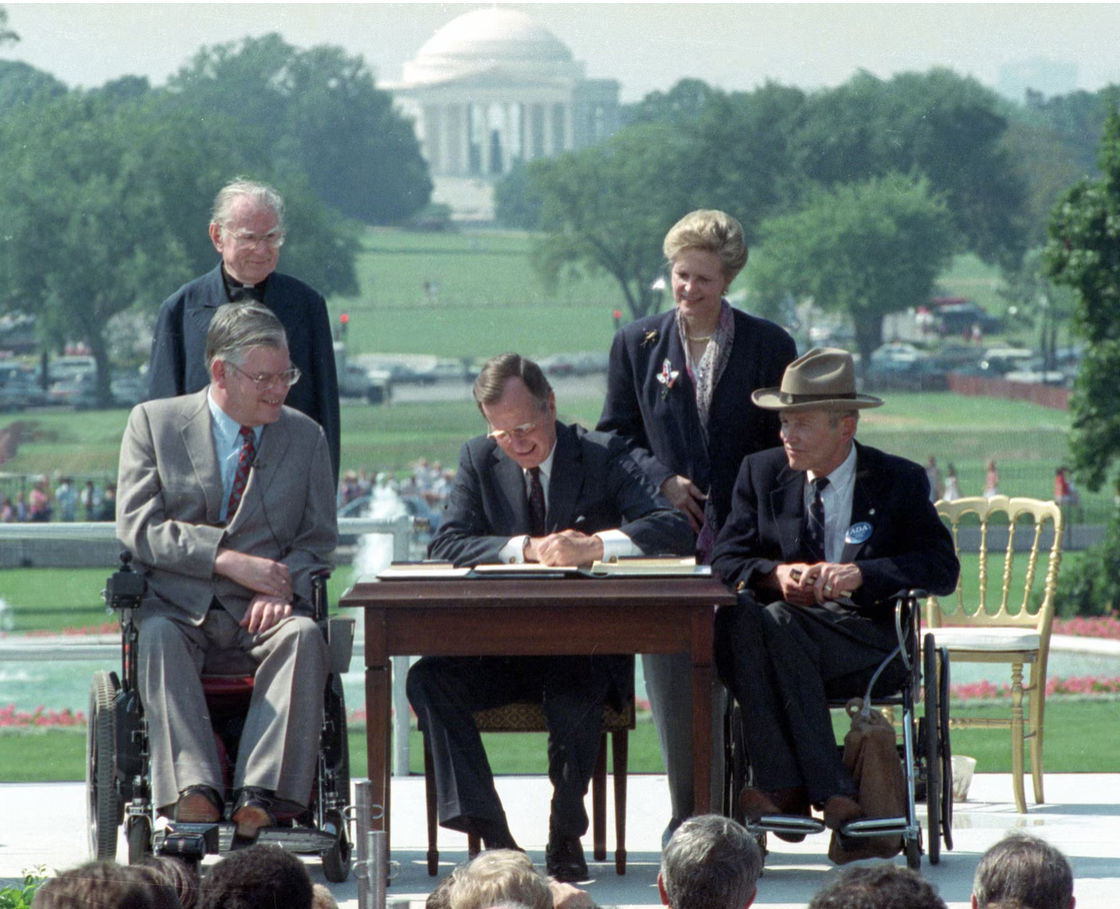
Since that day and to this moment, they are still trying to kill us.
Not with gas chambers. Not with firing squads. With paperwork. With budget cuts. With waiting lists. With "inability to care for oneself." With a president who signed 'Ending Crime and Disorder on America's Streets' executive order 14321 on July 24th 2025 that encourages states to lock people with disabilities away in institutions and call it treatment.
On a plane, Jo asked for the wheelchair closet, a space specifically made to fit certain wheelchairs, and the flight attendants gave them trouble, but more about that later. Jo has been disabled for most of their life. They use an electric wheelchair because ankylosing spondylitis and other conditions have taken their arms, their hands, their legs, their feet, and their back. When they talk about freedom, they don't talk about ramps or parking spaces.
"Freedom is not just the absence of handcuffs," Jo says. "Freedom is the ability to decide where I live, who I worship with, who I love, where I work, and how I participate in my community."
That's the thing about freedom. It's not about access to buildings. It's about access to life. For disabled people, that access is under constant attack. 'Ending Crime and Disorder on America's Streets'. It encourages expanding institutionalization for people with mental health conditions. Particularly those experiencing homelessness. It calls for civil commitment based on subjective standards like 'inability to care for oneself'. It links housing and homelessness assistance to forced treatment. It directs the Attorney General to reverse court decisions that make it harder to lock people up. It prioritizes federal grants to states and municipalities that enforce bans on camping, loitering, and squatting. And requires recipients of federal housing assistance to collect health-related information and share it with law enforcement.
The American Bar Association calls it "a major step backward."
Jo calls it something else.
"It's not just a major step backwards," Jo says. "It's a step back into eugenics. It's a step back into the Ugly laws."
Eugenics is the pseudoscientific belief in improving genetic stock through controlled breeding. It has been used to justify forced sterilization, institutionalization, and the elimination of disabled people. It was practiced in the United States. It was practiced in Nazi Germany. And Jo sees it in this executive order.
The Ugly laws were laws in U.S. cities that made it illegal for people with visible disabilities to appear in public. They were designed to keep disabled people out of sight and out of mind. This executive order is the ugly law rebranded for the twenty-first century.
Jo knows this history intimately. They were born in 1979, back when females, clinical usage, were not diagnosed with autism. Instead, they were diagnosed with other things. An example being hysteria.
"I got diagnosed with hysteria and the "R" slur," Jo says. "So, it was quite a life that I had to fit and live and how far we have come."
Hysteria is a now-discredited diagnosis applied almost exclusively to women. It was used to control and institutionalize women who defied social norms. It was a tool of patriarchal and ableist violence. And Jo was labeled with it. Because the medical establishment didn't know how to see them.
"Females are now being diagnosed on a regular basis," Jo says. "That's why autism diagnoses are going up. It's not a pandemic. It's that they're finally diagnosing us."
But the weaponization of diagnosis didn't end with hysteria. In fact, it's still happening. One in three American adults has a diagnosis of some level of depression. That's not because more people are depressed. It's because the diagnostic net has widened. And this legislature is using that net to catch us.
"If you are disruptive in any way, inconvenient in any way, if you are unhoused, if you are disorderly, if you are demanding your rights to get recognized," Jo says, "they could say, 'Wow, this person is mentally ill and put you in a hospital.'"
Nisha is not physically disabled themselves, but their uncle had a stroke and now uses a wheelchair. She sees the same thing Jo sees.
"They're framing people with disabilities as dangerous to the public instead of framing it as if we treat people with disabilities to the point where, if it's exasperated, they might not be able to maintain or sustain a home. And now that we've made the situation worse, we've given them no resources and they're outside, we want to use this excuse to lock them up."
"But that's not why they're locking us up. They're locking us up because they're using us."
Jo agrees. And they know what that use looks like.
"You get used to do the farming or do anything they do at the prison and they do the same thing at the mental institution," Jo says. "There's test medication. They'll have you cleaning the grounds or they'll rent you out to places like McDonald's or Burger King to make them patties. And you don't get paid anything because it's 'to help you out'."
"When do those skills ever translate into income that you're allowed to keep? You're eventually disabled. Why would you need money? You're locked up and they are providing your food."
This is not care. This is not a treatment. This is eugenics with a legal framework. This is elimination.
"I call it a genocide," Jo says. "They're purposely killing us. They're purposely taking away our medications. They're taking away our health care. This is the only capitalist state without universal healthcare. And you can't go to another country if you're disabled. So you're fucked. You don't get to run away."
They're right. There's nowhere to go and no escape hatch.
"I would call it a genocide on disabled people," Jo says, "because they know we're going to die. And a lot of us are going to die. That's their goal. That's what they want."
Jo is losing their Medicaid and they've been denied SSI again. Meanwhile, they're waiting for the appeal letter so they can adjust the application as the denial letter requires. They'll need community based services as they try to secure a food box once a month from their local pantry, but they've been unsuccessful in trying to get food stamps for the last two months.
"When we don't have the money to give to the organizations that are feeding us, and we're not putting money into things like food stamps, as the price of food goes up, people are going to start to starve," Jo says.
The disability trap is designed to catch you no matter what. Jo has Ankylosing Spondylitis. To qualify for SSDI, they would need to lose both eyes, both hands, or both legs.
"Even if I lost one, that wouldn't be enough," Jo says. "They just have ridiculous requirements." Part of that is being unable to move a given body part farther than 30 degrees, which is only 25% the distance an elbow has to twist to reach for a doorknob, and 50% the turning distance to see someone approaching to the slight right or left. You're expected to be painfully stiff.
Story, whose father was in the hospital toward the end of his life, saw firsthand the misery of missing a foot and repeatedly having to prove that he still doesn't have a foot. He passed away recently. They watched him try to get care and find nothing but dead ends.
"He needed help a lot sooner," Story says. "I was trying to get him into nursing care. People did not have any sort of information on how to help."
What they found instead was "resources that are just a list of other resources, that are just a list of other resources, that are phone calls, that waste our time and go nowhere."
They had to pay for everything out of pocket. "I just got a bill for $2,300." There are hospitals that are subsidized by the state for also being teaching environments for students. Some states don't make enough money to do so or outright refuse to subsidize hospitals because prisons want more labor.
But the bill is more than a bill. It's a message.
"They want to, by putting all of the burden on the family, they have created the subtext of 'don't you wish he died sooner?' And every single manipulation in this legislature, in the social consciousness, is pointing in that direction: being a burden of any kind means you should die. That's deliberate," Story says.
"The bill is a statement. It's not just the billing statement. It says it in words. It says it right there: 'Here is your statement.' That's what it's saying. 'Don't you wish he'd died sooner? Wouldn't it be better if we didn't try so hard?' And all of it is turning that direction. They're gonna throw us in the pit where they don't have to look at us."
Jo got taken off asthma medicine they'd been on since they were eight years old. It was effective. Then their health insurance just stopped covering it. They had to switch to something that doesn't work as well.
"Now I've switched to plants," Jo says. "I've given up on the medical system."
Then there's the hospital. Jo was in the hospital last month for, basically, heart failure. "Their heart wouldn't beat above forty beats a minute and hospital staff didn't even bother putting them in a bed. Jo was left to sit in a hallway of the emergency room, ultimately falling asleep." In that long wait, no professional checked on Jo while he was visibly ill. The process ended in him going home without answers and the discovery of Medicaid refusing to cover the visit.
"And to put that in the context of this legislature," Jo says, "they're talking about institutionalizing more people, putting them in full-time care of this system that left you in the hallway. It is a death sentence."
Helaine is sixty-five years old. Their stroke left them blind and with cognitive impairment. Their mother is in a facility with Alzheimer's or Dementia. There's a camera in her room. The camera revealed abuse from her assigned caretaker and although the person was fired, under the new policy, there's a chance they wouldn't have a camera to begin with.
"It's so sad because it shouldn't be that way," Helaine says. "Her Medicare is a big part of her care and it makes me want to throw up because she couldn't survive without it."
Lind is a disabled advocate and a former lab tech. They worked at a children's hospital, as an advocate for the disabled; witness to the common abuse in these facilities.
Jo's father-in-law had Alzheimer's with dementia and needed twenty-four-hour care. He was first in a "medium, decent home." The front of the home was for insurance patients. The back was for Medicaid patients.
"There was rarely a nurse on the floor," Jo says. "He wasn't getting bathed. He wasn't getting cleaned up after meals. His medication wasn't on time."
Initially, he was in a "medium decent home," where the front of the house was for insured patients, leaving the back of the house for Medicaid patients.
"I couldn't go in there anymore," Lind says. "The smell, the people that were just roaming the hallways, some people just sitting in the corner in a wheelchair. People in their bed are just bed-rotting."
"It was like no one was being taken care of anymore."
Nicholas K. Young, MDiv, LMSW, is a therapist and minister. They too see the moral bankruptcy of these cuts.
"My concern about major Medicaid cuts is that we will push even more people into crisis before they qualify for help," Nicholas says. "Therapy becomes an emergency room visit. Preventive care becomes hospitalization. Stable housing becomes homelessness. It is not just financially shortsighted. It is morally shortsighted."
They also see the invisible labor that families provide when it should be the system's responsibility.
"Many people have no idea how much invisible labor families provide every single day. Transportation. Medication management. Appointments. Advocacy. Emotional support. Coordinating services. It is a second full-time job that often goes unnoticed."
Jo's grandson is in school right now and is being evaluated for accommodations. It's been observed he'll need speech therapy, special education and behavioral support after having bit two other children at school. But it's been made quite certain after the child struck ten other children at a meeting, while his mother was still present.
"If he loses access to this, he's gone," Jo says. "Like, his education's gone."
They know what happens to disabled kids who don't get the support they need.
"Without IDEA, without IEP, he's going to be put in an institution and they don't educate in institutions. No schooling at all, usually."
This is not an exaggeration. In the past, institutions have had, on average, sixty to one hundred people per staff member.
"They don't have time," Jo says. "If you've got seventy-five kids that you've got to take care of all day, how are you gonna take the time with each child to help them learn at their level?"
Even a local children's hospital psych ward is one to forty; one caregiver for forty patients.
"There's like maybe one or two child life specialists in a median children's hospital," Lind says. And if you want tutoring for your kid? "You would have to pay out of pocket for any tutoring. If your kid has cancer, you would be paying for tutoring and doing stuff through that. But the teachers aren't allowed enough in the wing. They keep those wings locked up really tight."
Nisha had an IEP when they were in school. It made a clear difference.
"When I was just thrown into a class with a bunch of other kids, it was hard for me and I did terribly in those classes," Nisha says. "The classes where it was just me and a few other students with another adult in the room that was able to answer my multiple questions, I was able to succeed."
But in the bigger classes, they felt like a burden.
"When I kept asking multiple questions in other classrooms with like thirty other kids, I felt like I was bothering the students because I kept asking all those questions."
Nicholas thinks about the children they've worked with over the years.
"Especially Black boys who were brilliant but misunderstood," Nicholas says. "Some needed accommodations. Some needed counseling. Some simply needed one adult who believed in them. Without those supports, many of them would have been labeled as behavioral problems instead of children with tremendous potential."
"When we weaken the systems that protect students with disabilities, we are not just cutting programs. We are narrowing futures. We are telling families that they will have to fight even harder just to secure what the law already promises their children."
Helaine has grandchildren who are too young to know what they'll need from the education system.
"It's frightening," Helaine says. "One is being homeschooled but I don't know what will happen and our others are so little."
The ADA was supposed to protect us, but rights without enforcement are not rights. They are suggestions.
Reports show staff reductions at the DOJ Civil Rights Division and the Department of Education's Office for Civil Rights. Federal enforcement of the ADA is weakening.
"The law is largely complaint-driven, which puts the burden on disabled individuals," Equal Accessibility notes. And as Adam Flores-Boffa writes in the San Antonio Report: "Disabled people can file reports and grievances, but the only real avenue for action is litigation, often at the plaintiff's expense. Businesses both large and small can remain out of compliance for years, and only when faced with litigation are they compelled to make changes."
Lind knows this all too well.
"The ADA is already not enforced, and when we ask for it to be enforced, we are the ones penalized."
Lind was kicked out of a gas station for asking for ADA accommodation.
"Those are my legs," Jo says. "Those are literally my legs. You are in charge of my legs. Please keep them safe." This was the start of the big trouble on an airline.
Nisha didn't even know there was a wheelchair closet. "And I fly Southwest all the time." They knew about wheelchairs getting broken on flights, but not about the designated area for them. "Why are people putting their personal stuff in there when that's made for the wheelchairs?"
Jo adds, "I was able to upgrade to first class with points. I was a first-class white person fighting for my spot in that wheelchair closet. A coach person of color? You're not getting it."
Helaine has a guide dog. "She is allowed anywhere. If the change happens, they wouldn't allow me in with her." They've had restaurants try to kick them out. "In my twenty-three years of being disabled, it's embarrassing and uncomfortable, but by myself she makes sure I don't run into things or hurt myself."
Nicholas puts it plainly.
"The ADA was never simply a document. It was a promise that disability should never determine whether someone gets to participate fully in society. When enforcement disappears, rights become theoretical. People with disabilities should not have to become lawyers or public advocates just to receive equal treatment."
Helaine has no faith in the system.
"I have no idea. I make my calls and that type of stuff, but I don't have a lot of faith right now."
Public discourse increasingly frames community living and mental health through a "public safety" lens. Disabled presence in public spaces is viewed as a threat rather than a fundamental right. The executive order explicitly links homelessness, mental illness, and drug use to public danger.
Jo sees this for what it is and spoke further on that.
"Seeing us that way is eugenics. People need to learn what eugenics are. And realize where eugenics came from, and understand that it's been used extensively in our past to get rid of us. Not just when we were tested on and killed in the Holocaust, but as well as America and their solution for us. The West is very good at eugenics and we stick to it."
Lind added: "We're just people. We're just people with a problem."
And they make a point to exist in public, to make people angry in the process, just by existing.
Lind describes waiting for the accessible stall in a bathroom. Someone came out after "blocking it up" and gave them a dirty look for waiting.
"They were implying that you with your wheelchair could use any other bathroom with ease."
Nisha sees the framing and what it is, legal jargon.
"One of the big things about the executive order is that they're framing people with disabilities as dangerous to the public instead of framing it as if we treat people with disabilities to the point where it's exasperated, they might not be able to maintain or sustain a home. And now that we've made the situation worse, we've given them no resources and they're outside, we want to use this excuse to lock them up because they're a danger to the public."
"But that's not why they're locking us up. They're locking us up because they're using us." Jo connects that statement with experience, voicing their own opinion on the dissonance.
"Mental disorders are usually caused by something, usually dissonance. There is a dissonance going on right now. The way we should be treating each other as humans compared to the way we are treating each other as enemies. And so anyone that's different is an enemy instead of just another person, another human."
"We see the truth. We start standing up for the truth and then we are the T-word because what's the answer to nothing working? It's terrorism. And you can't fix it without being a T-word. Terrorist is the T-word."
Nicholas draws a clear distinction, a clinical distinction.
"There is a profound difference between someone needing support and someone posing a threat. Those are not the same thing. When we begin treating disability, homelessness, or mental illness primarily as public safety issues, we stop seeing people as neighbors and start seeing them as liabilities."
Nicholas cements their stance, "as a pastor, I cannot separate this from my faith. Scripture consistently calls us to move toward vulnerable people with compassion, not suspicion."
Helaine's response is simple, "it's painful and infuriating. No one in my community has told me that."
Advocates describe the combined effect of policy rollbacks, reduced ADA guidance, and funding cuts as an "all-out war" on disabled people.
Jo doesn't hesitate to opine.
"I call it a genocide. They're purposely killing us. They're purposely taking away our medications. They're taking away our health care. This is the only capitalist country without state healthcare. And you can't go to another country if you're disabled. So you're fucked. You don't get to run away."
"I would call it a genocide on disabled people because they know we're going to die. And a lot of us are going to die. That's their goal. That's what they want."
Nisha sympathizes with Jo.
"I agree with Jo. That's what I'm seeing. That's what I'm reading and hearing. The government and people are making it hard for disabled people to live. And it's terrible."
They ask the questions that shouldn't need asking.
"Why does it matter how many hours they are allowed to work? Or why does it matter how much money that they have if they can't get the proper healthcare or just be able to live? Why is the government so involved and get a say of what they can and can't do?"
Nisha immediately answers their own imperative.
"The government should provide for them at least their medicine, because that's what they need. But the government just should do better in general."
The cruelty of government micromanaging is something I can call out any day.
"It would be different if the government was involved because they were going to provide for people or assist people, but they're not involved to help people. They're involved to harm people."
"It would be different if our government was like, "Yeah, we need to know this information so we can provide you housing. We need to know this information so we can provide you with quality doctors to treat your issues." That would make sense. But it's just, 'We need to know so we can be cruel to you.'"
At that moment, I learned quite quickly: "It's more expensive to be disabled."
Jo knows that firsthand.
"My wheelchair is like $2,000. And my insurance didn't cover that. I was trying to get a wheelchair through my insurance, and that's when they did the cutoff and didn't do wheelchairs for a while."
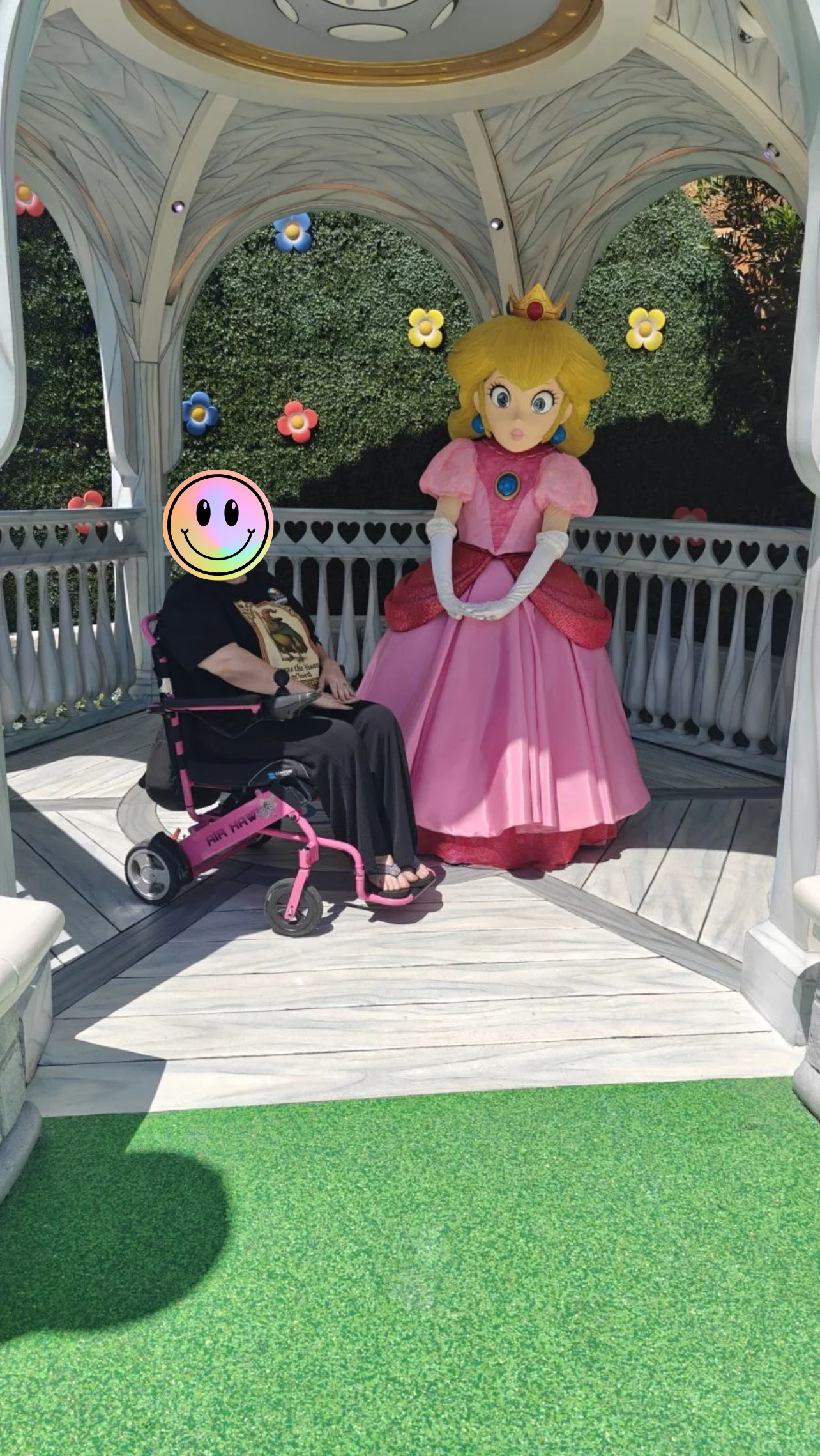
A blunt response from Lind followed, "They don't wanna see it. They don't wanna acknowledge that we exist. Nothing."
The disability trap is designed to catch you no matter what. Jo volunteers with Community Forge. But the state can use that to prove they can work, they will then lose SSI.
"If I use that, to continue getting my Medicaid, I won't be able to get my social security later. They'll tell me, "No, you obviously can work or you wouldn't volunteer"".
There's an underlying vernacular that's become foundational to the topic and Nicholas understands why people use the language of war to describe it.
"When policies consistently reduce access, weaken protections, and remove support, people experience the cumulative effect as an attack."
But they offer a different word, "the word I would probably use is abandonment. It feels like walking away from people who have already been asked to carry more than most of us can imagine."
Policy debates often feel abstract to the general public. However, for disabled people, policy is not abstract. It is the ramp that doesn't exist. It is the wheelchair that costs $2,000. It is the medication that gets cut off. It is the hospital that leaves you in the hallway.
Lind knows this intimately.
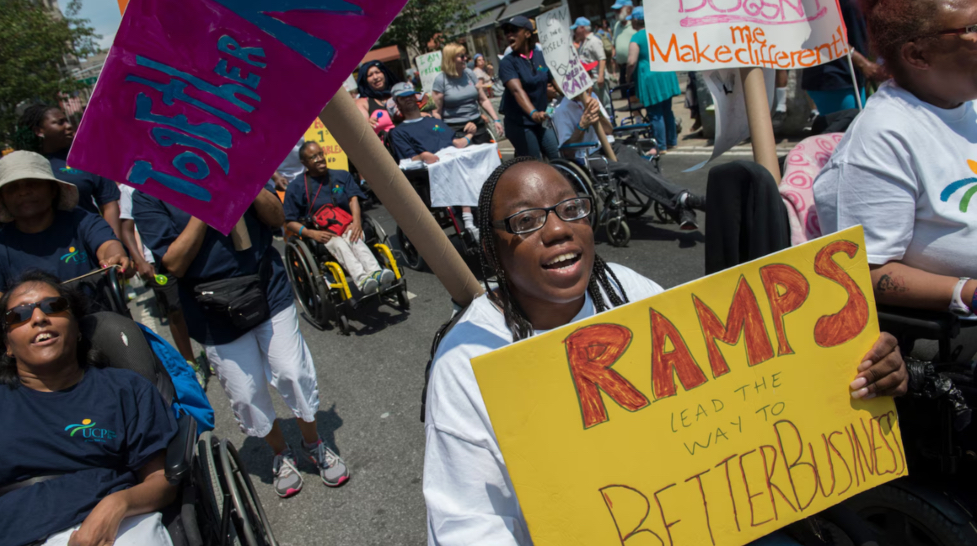
"I literally had to beg for a ramp outside of my psych office."
Lind found themselves needing a lawyer to write a strongly worded letter for the simple endeavor of obtaining a ramp, because they refused to do virtual visits. And it was the only specialist who took Medicaid.
Meanwhile, Jo sees a counselor who focuses on CPTSD, depression, anxiety, and chronic pain.
"When you're dealing with a therapist, if you're a chronic pain patient, you want someone who can focus on chronic pain. Because that's what, for a lot of us, where the depression comes from, 'I live in an 8, and that's where my medical treatment is.'"
"They want to get you down to a 4. You never get to be free in chronic pain. They want you to live in a 4. But because of higher restrictions on opioids, they can't up my medication to the point where I can lower my pain to a 4. So I live at an 8 in pain."
"If you get tired of living in this way, and you can't do anything, and your life sucks, it leads to a lot of depression."
Jo uses an electric wheelchair. "My disabilities are in my legs and my arms," they clarify. In California, a woman walking next to them said, "Oh, that's such a great idea to bring a scooter to the park."
Jo responded, "I would call it a wheelchair."
The tone deaf inquirer said, "Oh, well, I thought wheelchairs only get pushed by hand."
Jo explains, "Ma'am, my disabilities are in my legs and my arms."
The woman became visibly irritated at Jo's audacity to call what she thought was scooter, a wheelchair.
Nisha shares that their uncle had a stroke, an individual who also uses a wheelchair.
"It was hard to get him in and out of places sometimes because, in a wheelchair, the one that you push, two inches with a grown man sitting there, it is kind of hard. Having to lift the wheelchair and him up just to get him over that person's step."
"The aisles of the stores usually don't take them into consideration for bigger wheelchairs, let alone smaller wheelchairs. So you're gonna bump and knock everything down."
And then there are the bumps, the misshapen and often too-common bane of many wheelchair users.
"My wheelchair also doesn't go over bumps because it's an electric wheelchair and it's not a very super strong He-Man wheelchair. It's a little thing that just gets me around. And that is actually in a complaint to have the one two-inch bump." Jo says.
"If you're pushing somebody, you're supposed to have the door magically stay open. You've got to magically get the door open. You're supposed to turn them around and pull them backwards over the bump. If you're on an electric wheelchair, you're screwed. You're not going in that building. That building had a two-inch bump. So even if you have the ramp, if there's a one-inch bump to get on the ramp, it can't get on the ramp."
Nicholas' eyes and ears on this matter are the people across their desk.
"As a clinician, I experience Washington through the people sitting across from me. Policy is never just legislation. It becomes anxiety in a therapy session. It becomes burnout for caregivers. It becomes another family wondering why help is always one phone call away but never actually available."
Helaine thinks about the houseless people and where they live.
"I worry about what might happen. I can see when we are driving there, that there are communities that have formed and it would hurt me if they were not able to be together. It's not the gov's place to break up what people have worked out for survival."
Survivors seeking sanity and a semblance of community. In a difficult political climate, what keeps you grounded and motivated to continue organizing and writing?
Jo didn't hesitate to answer. "This is my life. This is my grandchild's life. Like, if I don't fight, I just die quietly. I will not go quietly into that good night. I'm stubborn. I want to prove them wrong."
Nisha's answer is simply, "I just want everybody to live happily and not struggle."
Lind's answer is even simpler, "y'all ain't got no hope." They laugh.
Nicholas finds hope in something deeper.
"Hope has never come from politics alone for me. It comes from watching people survive things they never thought they could survive. It comes from the young people I have mentored who found purpose after believing their lives had no value. It comes from the veterans, first responders, church members, and clients who continue showing up despite carrying enormous burdens."
"My faith teaches me that dignity is not something the government gives us. It is something every person already possesses because they bear the image of God. That belief keeps me doing this work."
Helaine finds strength in their grandchildren, their friendships, and their dogs.
Lind finds determination in their grandmother.
"She was the type that would literally always do for others, I have a picture of her physically carrying somebody when hiking. She was like, 'You want to go on a hike, you'll go on a hike."
The very same champion of cooperation even has a message for anyone who thinks they can simply push disabled people around.
"I'm not going anywhere. If I go to a place with steps, I'm gonna sit there and block your entrance until you find a way."
An inspired question remained, what is the single most important message you want the general public to understand about what is genuinely at stake for the disability community right now?
Jo wants you to know who they are.
"I'm a grandma. That means I was a mom. I raised two kids. Before that, I worked five years at McDonald's as the back drive-thru catcher. Because I was quick. And then when I left that job, I was your overnight Walgreens employee who made sure you got your prescriptions. And after that, I was your, depending on the shift, 24-hour, whenever shift, gas station employee, making sure you were taken care of."
"I've always been in this life to serve you as a person in my life. And I'm that way in real life, too. But I'm going to die. They don't care if I live. Just because I got injured at work. It can happen to anybody. I worked for 15 years or 20 years after I was disabled."
"I'm just a good person. I want to help people. And you want me to die? I'm so confused."
Nisha's message is compassionate.
"They're human. Like, for your loved one. My uncle, he's human. Just because he had a stroke doesn't mean he doesn't deserve rights. He doesn't deserve to be locked up. He doesn't deserve to die."
Lind had more to say, adding to Nisha's statement. "Just because we have a disability, it doesn't make us scary and it doesn't make us hateful."
Jo adds, "I like it when children come up to me in a wheelchair. I have stickers that I carry in my bag just to give to the children who come up and ask me questions about my disabilities."
Jo then directs themselves to the entirety of the disabled community.
"I'm a person. I have the heart of a parent. I was never allowed to have children because of my disabilities, but I was able to adopt and raise two. And I know what it's like."
"To the disabled community: I'm so disappointed at so many people in the disabled community, especially white people in the disabled community. Like, yeah, we're discriminated against. But Black people have it worse. They're discriminated against, not just for their disability, but for their color. Same as people of color. How can we be disabled, discriminated against, and want to stand up for ourselves, but not understand that other people are being discriminated against more? And we need to stand up for them too."
Nicholas offers their perspective.
"I would ask people to remember that disability policy is never just about disability. It is about every family that will eventually experience illness, aging, trauma, or disability in some form. These issues are not about them. They are about us."
"The measure of a society is not how it treats the strongest among us. It is how it treats the people with the least power. I hope we build a country that responds to vulnerability with investment instead of fear, with dignity instead of detention, and with community instead of isolation."
Helaine has one request.
"I would want them to ask people at risk how they feel instead of making assumptions."
And I, who gathered these stories and held a roundtable, just started learning new things about people with disabilities, but in the short amount of time that I've been focusing on this or learning about this, one thing I've learned almost immediately is that it's more expensive to be disabled.
I've been sitting with these conversations for weeks now. Not because the stories are hard to hear, though they are, but because of how ordinary they've become. Jo rationing asthma medication, or watching their father-in-law rot in a Medicaid wing. Story staring at a $2,300 bill that reads like a verdict. Helaine wondering whether the camera in their mother's room will be allowed to stay. Nisha lifting their uncle's wheelchair over a two-inch step. None of this is exceptional and that's the point. This is what disabled life looks like in America right now, and most people don't see it because most people don't have to.
Final Thoughts
I keep coming back to something Jo said. "I'm just a good person. I want to help people. And you want me to die? I'm so confused." That confusion isn't naivety. It's the sound of someone who spent their whole life contributing, working, raising kids, volunteering, showing up, and is now being told, through policy and paperwork and waiting lists, that their life isn't worth the cost of keeping. That's not an accident. That's a decision, a deliberate thought someone made. A president wrote it and then signed it, an agency to enforce it. And the rest of us are supposed to call it fiscal responsibility.
Admittedly, I don't have a neat ending for this, no policy recommendation that will fix it, and I'm not sure one exists that doesn't require a fundamental shift in how this country decides who deserves to live. What I have is what these people have given me: their time, their stories, their anger, and their insistence that I not soften any of it. So I won't. What's happening isn't complicated. It's not a budget crisis or a philosophical disagreement about the role of government. It's a choice to let people die because keeping them alive is inconvenient. Jo calls it genocide. Nisha calls it cruelty. Nicholas calls it abandonment. I call it what it is: the quiet, bureaucratic killing of people who were never given the chance to fight back.
But here's what the people in this piece want you to understand: they are fighting back. Every day. In small ways and loud ways that cost them more than most of us will ever know. Jo volunteers. Lind blocks entrances. Nisha shows up for their uncle. Story advocates for their father even after he's gone. Helaine keeps calling. Nicholas keeps sitting with people in rooms where policy becomes grief. I kept asking questions. None of them have the luxury of giving up and neither do you. Not if you care about anyone who is aging, sick, disabled, poor, or one bad accident away from needing the systems they're dismantling. Which is to say: not if you care about anyone at all.
The people in this piece are not asking for your pity. They're asking for your attention, your action, and your refusal to look away. They're asking you to see them as people, not burdens, not statistics, not problems to be managed. They're asking you to understand that what's happening to them is happening to all of us, whether we admit it or not.